
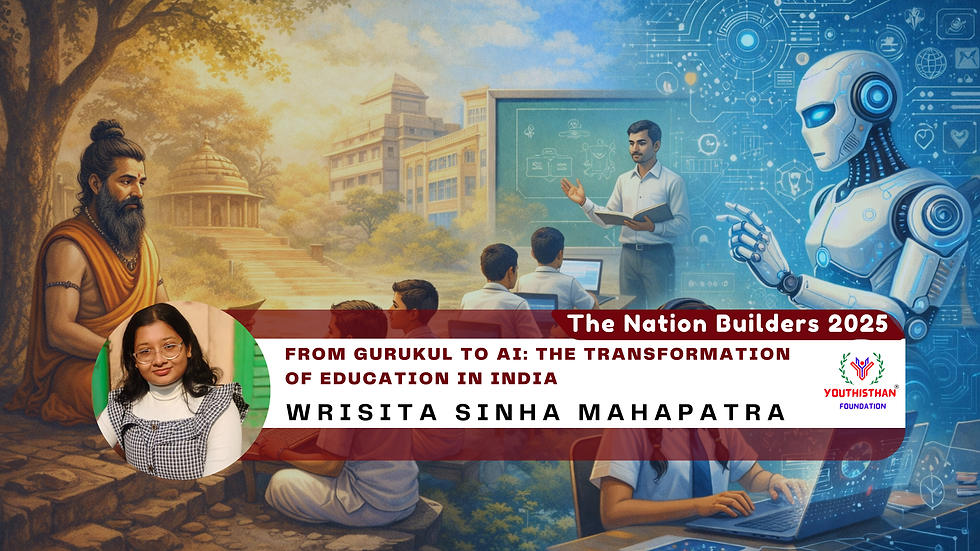
From Gurukul to AI: Transforming the mode of teaching


Evolution is a universal phenomenon applied to every visible or invisible entity of the universe. Not only are creations of the universe evolving with time, but the systems governing our lives are also undergoing changes, and the education system is no exception. With time, it has transformed a lot: the mode of imparting education, the equation of teachers and students, the criteria for judging students, and even the meaning of education have all changed.
Since the time the human race came into existence, we humans have been eager to reason every mystery of the universe, and the only way is by gaining knowledge. During the pre-Vedic and Vedic era, knowledge was considered too sacred to be written and thus was imparted via oral tradition. It was believed that only a Guru, the bearer of knowledge and wisdom, had complete authority to pass it to his devoted disciple, who, in turn, could pass this knowledge to his disciples, thus keeping the tradition of Guru-Shishya alive; this tradition of Guru-Shishya was the foundation of Gurukul.
It is difficult to trace the origin of Gurukul; even in mythology, there is mention of Lord Rama and Krishna getting their formal education in Gurukul under the guidance of their respective gurus, Guru Vashistha and Guru Sandipani. In the Gurukul system, the shishya has to reside with his Guru during the course of his education, where he not only learns what his Guru teaches him but also imbibes morals and ethics by observing the conduct of his Guru in daily life. The shishya surrenders himself to his Guru, who, in turn, treats his shishya as a member of his clan (kul), hence the name Gurukul.
With time, the Gurukuls of the Vedic era underwent modifications, and some of those modified Gurukuls were Takshashila (1000 BC to 500 AD), Nalanda (425 AD to 1205 AD), Vikramshila (800 AD to 1203 AD), Vallabhi (600 AD to 1200 AD), and many more. The curriculum of these Gurukuls or universities was quite vast, and teachers were so eminent that they attracted students from across the world. The grandeur of those Gurukuls was such that one of the largest libraries of that time was Dharmaganja of Nalanda.
The unparalleled quality of their education can further be corroborated by the eminent scholars they gifted to the world. Some of the greatest alumni of those universities were Panini, Acharya Chanakya, Jivaka, Varahamihira, Aryabhatta, Bhaskaracharya, Brahmagupta; the list is endless, and the knowledge they shared with the world is still serving as the guiding light for us. The contributions of those Gurukuls to the glory of Bharatvarsh are incomparable.
But as we know, nothing is everlasting; several invasions and attacks from foreign powers led to their decline, and Macaulay's win in the debate on "A Minute on Indian Education" served as a death sentence for those Gurukuls. Thomas Babington Macaulay is the man behind the current education system and thus is regarded as the Father of Modern Education in India. In a debate between Orientalists, favouring teaching in Indian languages and traditional Eastern subjects, and Anglicists, who advocated for Western education via English medium, the winners were the Anglicists; then the English Education Act of 1835, making English the primary language of education in British India, changed the fate of the whole Indian education system.
Present-day schools, affiliated to different boards—be it CBSE, ICSE, or state boards—are still operating the way the Britishers introduced. The innovative and practical way of Gurukul teaching, where the whole environment around the student was his laboratory, was replaced by confining students within the four walls of classrooms; instead of application-based teaching, rote learning is promoted. The current education system lacks variety; here, the same dish is served to all, irrespective of their appetite, their innate talents, and mental abilities.
Instead of helping students choose their own path and develop high morals and ethics, the current education system makes them compete with each other for materialistic gains, thus transforming the beautiful journey of life into a never-ending rat race. And now, with the introduction of Artificial Intelligence (AI), the mode of teaching has shown a drastic transformation; the credit for this, to some extent, goes to John McCarthy, the Father of Artificial Intelligence. AI has penetrated every arena of our lives, and the education sector is no exception.
As per the reports of some surveys, India stands globally at the third position in using AI for education and productivity tools. It is reported that 92% of students from schools to university level are using AI tools in 2025, and the usage has increased drastically from 66% in 2024 to 92% in 2025 based on data collected till July-August 2025 (source: internet).
The education system has shown a transformation from treating the whole environment as a learning ground to studying within the four walls, and now it has been confined to gadgets of a few inches. Every system—be it Gurukul, day-boarding, or AI—has its own pros and cons, but AI having more cons than pros is open for debate. No doubt, the introduction of AI has benefited students a lot, especially those who don't have access to academic libraries, can't afford costly books and courses, or can't travel to faraway places for education; the main advantage is that help is available instantly anywhere and anytime—all one needs is a mobile phone and an internet connection.
AI has penetrated so much into the education sector that its chatbots are now serving as virtual tutors, solving queries of students, providing study material, even giving tips for improvement, and much more. It saves a lot of time and effort, not only of students but also of teachers. No one can deny the fact that the boon of AI has made life easier; every piece of information is now accessible just at the click of a finger.
But can anything artificial hold the same value as the original? Can anything virtual ever replace the real? Can information be termed a synonym of knowledge? The answer of the majority of us will be "no," yet somehow our actions contradict it.
Though the transformation in the mode of teaching from ancient Gurukuls to AI appears progressive, in my opinion, to some extent, it is also retrogressive. The aim of Gurukul was the welfare of students; teachers there not only helped students in improving their intellectual capabilities but also guided them on the path of morality, ethics, and spirituality. The bond of Guru-Shishya was pious and purely based on mutual respect, gratitude, and dedication; it was free from the malice of materialistic and personal gains.
There was no discrimination amongst students on the basis of their financial status, and education was free for all. Those were the times when a Guru was worshipped as God. Then came the classroom-based system where knowledge became confined within the boundaries of classrooms and textbooks, and the parameter of progress is set by rote learning and grades.
The students there, irrespective of their capabilities and inclination, are forced to follow the same materialistic path where everyone is competing with others, and where one's worth is judged not by their knowledge and ethics but by degrees and financial status. And now is the emerging era of AI, where one gets whatever information is required without much effort, but information is not knowledge, and the real purpose of education is to provide knowledge and wisdom, which only a learned Guru can provide.
AI serves us what we ask for, but a teacher knows what we actually need to learn to overcome our shortcomings and thus guides us in the right direction. In our country, since time immemorial, the Guru holds a position higher than God, and books and knowledge are regarded as holy as Goddess Saraswati; students were thirsty for knowledge, and a sense of indebtedness and devotion towards the Guru was always there, and in gaining knowledge, a lot of dedication, patience, and effort were required.
But this is not the case in the fast-paced world of AI. Why? Because anything artificial can never develop a sense of true devotion and dedication. AI is a mode of providing information, not knowledge; knowledge is something which is gained by a lot of patience, experience, and dedication.
Though it's nearly impossible to revert back to our glorious Gurukul system, yet an amalgam of ancient and modern ways of imparting education can be adopted to help students gain knowledge and wisdom, to remain grounded, to face challenges of life with courage and dignity, and also to soar high, achieving their dreams and fulfilling their duties, thus making everyone proud. Real progress is in moving forward with new ideas and approaches aiming at the betterment of the whole world, discarding the negatives of the past and present, and carrying forward the wisdom of our Gurus and the positives of every system and tradition. And for that, we need to understand the true meaning and essence of education, which is not merely providing theoretical and information-based learning but contributing to the overall development of students, thus transforming them into responsible citizens of tomorrow.


Well analysed and written. Keep up.
Really good perspective
Very true ...
thought provoking article .
Great, keep it up.....points are written with good knowledge instead of information
Useful information