
From Gurukul to AI: The Transformation of Education in India

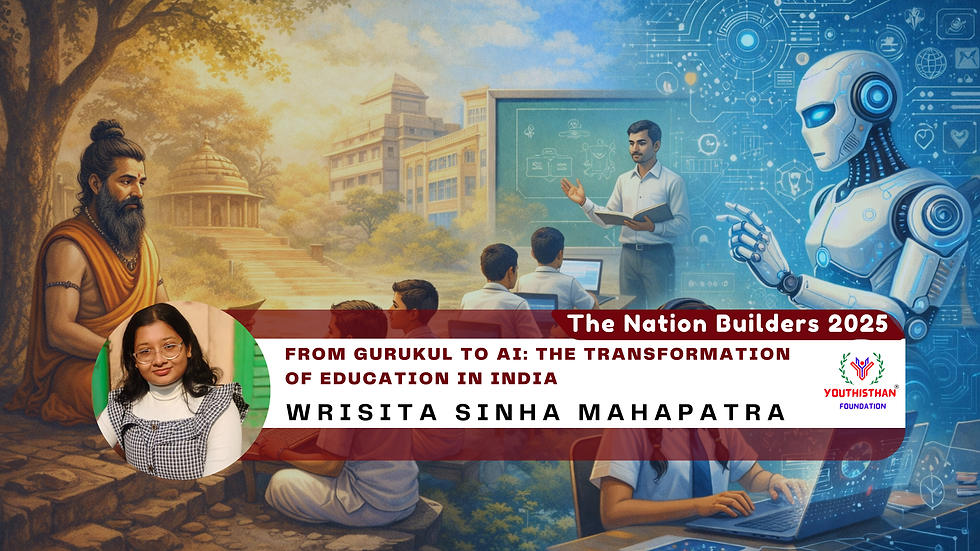
The transformation of education in India is a profound narrative, reflecting a journey from an ancient, personalized system rooted in philosophy and mentorship to a standardized, mass model, now undergoing rapid digitization.
The Gurukul system represents India's indigenous model of teaching, characterized by its relational depth and holistic development philosophy. Dating back to ancient times, this structure mandated a residential setup where students, or shishyas, lived with their teacher, the Guru, in the Guru's home. This physical proximity and shared life fostered a deep, personalized bond known as the Guru-Shishya relationship, which was central to the entire educational experience. The curriculum was comprehensive, encompassing not only academic knowledge but also moral and spiritual development. Pedagogy relied heavily on oral transmission of knowledge, memorization, and practical application, covering subjects as diverse as the Vedas, mathematics, astronomy, music, arts, and martial arts. Crucially, the system emphasized character building alongside academic rigor. Teachers functioned fundamentally as mentors and guides, focusing training programs on cultivating empathy, communication, and emotional intelligence in students. The goal was to shape well-rounded individuals, instilling essential values like discipline, respect, and humility through direct observation and hands-on experiences. This system views the teacher not merely as an instructor, but as an irreplaceable, highly personalized guide.
The advent of British colonial rule, particularly the reforms spearheaded by Thomas Babington Macaulay, introduced a foreign and disruptive model that permanently altered the foundation of Indian pedagogy. Macaulay's Minute on Indian Education, delivered in 1835, and the subsequent English Education Act of 1835, acted as a powerful keystone for British Indian educational policy. This policy fundamentally shifted the medium of instruction to English and prioritized Western knowledge. The stated goal of the policy was to create a class of persons, Indian in blood and colour, but English in taste, in opinions, in morals, and in intellect. This structural intervention led to the gradual erosion of indigenous centers of learning, as Indian epistemologies, philosophies, and scientific traditions—such as Ayurveda, astronomy, and traditional mathematics—were neglected in favor of a Eurocentric curriculum focusing on European history, culture, and ideas. This structural standardization, necessitated by the administrative requirement to produce clerks and officials, effectively reduced the comprehensive moral and academic Guru to an interchangeable knowledge provider focused purely on standardized curriculum transmission. This shift toward content coverage and preparation for standardized assessments gave institutional rise to the didactic, industrial-era chalk-and-talk teaching method. The inherent tension introduced by this historical shift, which replaced relational, holistic education with information delivery, created the pedagogical rigidity that modern, personalized AI systems are now attempting to overcome.
Following independence, the focus of the Indian education system shifted toward massive expansion to achieve universal mass literacy and access. However, the foundational structure largely retained the centralized, standardization-focused framework inherited from the colonial administration. The primary pedagogical emphasis remained on syllabus coverage and preparing students for standardized, high-stakes examinations. This structural inheritance reinforced the teacher's primary operational role as a content transmitter, a specialized role deeply divorced from the holistic mentor model of the Gurukul. The continued cultural emphasis on rote learning and standardized testing sustains profound institutional friction. While modern policies, such as the National Education Policy NEP 2020, explicitly aim to foster the facilitator and mentor role, echoing the personalization of the ancient Guru, the enduring system of assessment acts as the single strongest mechanism perpetuating the colonial teaching model. Teachers intellectually endorse the shift toward facilitation, but they are operationally constrained by assessment systems designed solely for content providers, creating a challenging dichotomy for educational reform.
The path toward the current AI-driven environment was paved by decades of incremental technological policies aimed at achieving the cardinal principles of access, equity, and quality across the vast and diverse educational landscape. Initial policy interventions focused primarily on introducing basic digital infrastructure into schools. Early initiatives, such as the scheme of Educational Technology 1972 and the Computer Literacy and Studies in Secondary Schools CLASS scheme 1984, were eventually merged to form the ICT@Schools scheme in 2004. This framework began the process of integrating Information and Communication Technology ICT into the school system. The scheme was revised in 2010 and 2011 to expand coverage and prioritize educationally backward blocks and areas with concentrations of historically marginalized communities. Key infrastructure goals included providing 10 PCs or nodes connected via a server and aiming for a minimum of 2 MBPS broadband internet connection in each school. Policy components also included developing quality e-content, mainly through central bodies like the Central Institute of Educational Technologies CIET and regional institutes, and offering teacher-related interventions such as the National ICT Award scheme for motivation and professional development. These steps, reinforced by the post-2015 Digital India Campaign, established the initial government commitment to treating digital infrastructure as a core utility necessary for citizen empowerment and a knowledge economy.
Despite decades of incremental ICT policy, widespread adoption was slow until the COVID-19 pandemic provided an unexpected and powerful catalyst. The global closure of educational institutions forced authorities to direct all academic activities online to ensure continuity rapidly. This forced online migration immediately exposed the severe inequalities arising from the infrastructure deficit—institutes with adequate resources adapted, while many others struggled profoundly to create a functional digital learning environment. This period of rapid technological innovation transitioned into the educational movement known as Education 4.0, which necessitates transforming education using Fourth Industrial Revolution 4IR technologies, including Artificial Intelligence. The crisis conditions validated the need for radical, integrated technological solutions far beyond simple computer literacy.
The strategic response was swift—the Education 4.0 India project was launched in May 2020 by the World Economic Forum WEF, UNICEF, and YuWaah, specifically to address the pandemic's exacerbation of learning inequalities through digital means. This project became a benchmark, bringing together over 40 partners from the Ed-tech sector, government, and academia, accelerating policy movement and integrating sophisticated technology at a pace that might otherwise have taken years under normal political cycles. Despite these efforts spanning two decades, subsequent research confirms that the infrastructure deficit remains a persistent policy and resource allocation challenge. The goals set by the 2010 policy, such as basic connectivity, are constantly challenged as technological requirements increase, moving from simple data access to the high processing demands of AI. Research as recent as 2025 still identifies inadequate infrastructure in rural and economically disadvantaged areas and a widespread lack of access to digital devices as substantial, fundamental barriers to achieving equitable AI adoption.
The NEP 2020 strategically links technology integration with the principles of access, equity, quality, and administrative streamlining. The policy mandates the use of technology for online and digital education adequately to address concerns of equity. This principle is applied across various dimensions—improving teaching-learning processes, evaluating student outcomes, supporting teacher preparation, removing language barriers, and increasing access specifically for Divyang students (students with disabilities) through specialized software development. Furthermore, the policy promotes and expands key public digital infrastructure, specifically mandating the development of a wide variety of educational software in all major Indian languages. This e-content must be developed and uploaded onto the DIKSHA platform, which the policy aims to optimize and expand.
The NEP 2020 acknowledges the emergence of Disruptive Technology and AI, demanding a rigorous and responsible national approach to implementation. The policy calls for extensive research into new technologies, including artificial intelligence, machine learning, blockchains, and adaptive computer testing. Before any digital intervention is scaled up, the policy strictly requires that its use and integration be rigorously and transparently evaluated through carefully designed pilot studies in relevant contexts.
AI is rapidly gaining traction in Indian classrooms and policy frameworks. Empirical research provides a clear quantitative view of the technology's pedagogical and administrative impact across the educational system. A systematic review examining 100 peer-reviewed studies published between 2020 and 2025 confirms the dominance of certain trends in AI implementation in Indian education. The analysis revealed the most prominent applications are personalized learning platforms, AI-driven assessments, and Intelligent Tutoring Systems ITS. However, the same review confirmed significant structural challenges, noting that research is currently concentrated in urban, private institutions, with limited representation from rural and government schools, thus limiting the generalizability of some findings.
ITS and personalized learning platforms represent the vanguard of AI in India, functioning essentially to simulate the one-on-one, adaptive teaching experience characteristic of the Gurukul system. These systems dynamically adjust content, pace, and feedback based on individual learner profiles. Specific commercial examples include AI-powered apps like Mindspark and conversational AI chatbots that simulate individualized teacher interaction.
Furthermore, specialized government initiatives are emerging, such as Auticare, an assistive technology platform utilizing virtual reality scenarios based on applied behavior analysis to assist learners with autism, aligning with the policy focus on Divyang students. The impact of ITS is quantified—these tools have documented positive effects on student motivation, engagement, retention, and test scores, particularly in subjects like mathematics and science. They are noted for boosting learners' confidence and enhancing academic performance by offering real-time feedback and adaptive pathways, especially beneficial for students in under-resourced schools.
AI tools are optimizing the rigorous, standardized assessment processes inherited from the colonial era by introducing consistency and objectivity. Applications include automated grading for essays, quizzes, and MCQs, with Natural Language Processing NLP being explored for automated essay scoring and paraphrase detection. By providing consistent and unbiased evaluations, these systems reduce the assessment burden on teachers and significantly reduce the time lag (latency) in feedback delivery, allowing students to identify weaknesses earlier. Furthermore, predictive analytics is an essential application, leveraging clustering algorithms and neural networks to mine student performance data and behavioral logs. These tools identify at-risk students or predict potential dropouts, enabling early interventions by educators to address disengagement and reduce overall dropout rates.
The modern teaching mandate redefines the educator's primary function. Teachers are transitioning from being the sole knowledge providers to becoming learning facilitators. This involves integrating technology, social-emotional learning, diversity, and collaboration into teaching practices to effectively prepare students for a complex and uncertain future. This new role definition is highly aligned with the core principles of the Gurukul system, which emphasize building trusting relationships, fostering empathy, and providing personalized support. This evolution means AI is not a replacement but a sophisticated structural tool. By automating assessment, content delivery, and administrative burdens, AI grants the modern teacher the necessary bandwidth to fully embody the high-value, individualized mentorship that Indian education policy is striving to reclaim from its ancient past.
The evolution of teaching in India, spanning from the ancient Gurukul to the integration of Artificial Intelligence, represents a complex historical and technological convergence. The current era seeks to reconcile the relational depth of indigenous pedagogy with the efficiency and scalability required by a modern, mass education system.


Comments